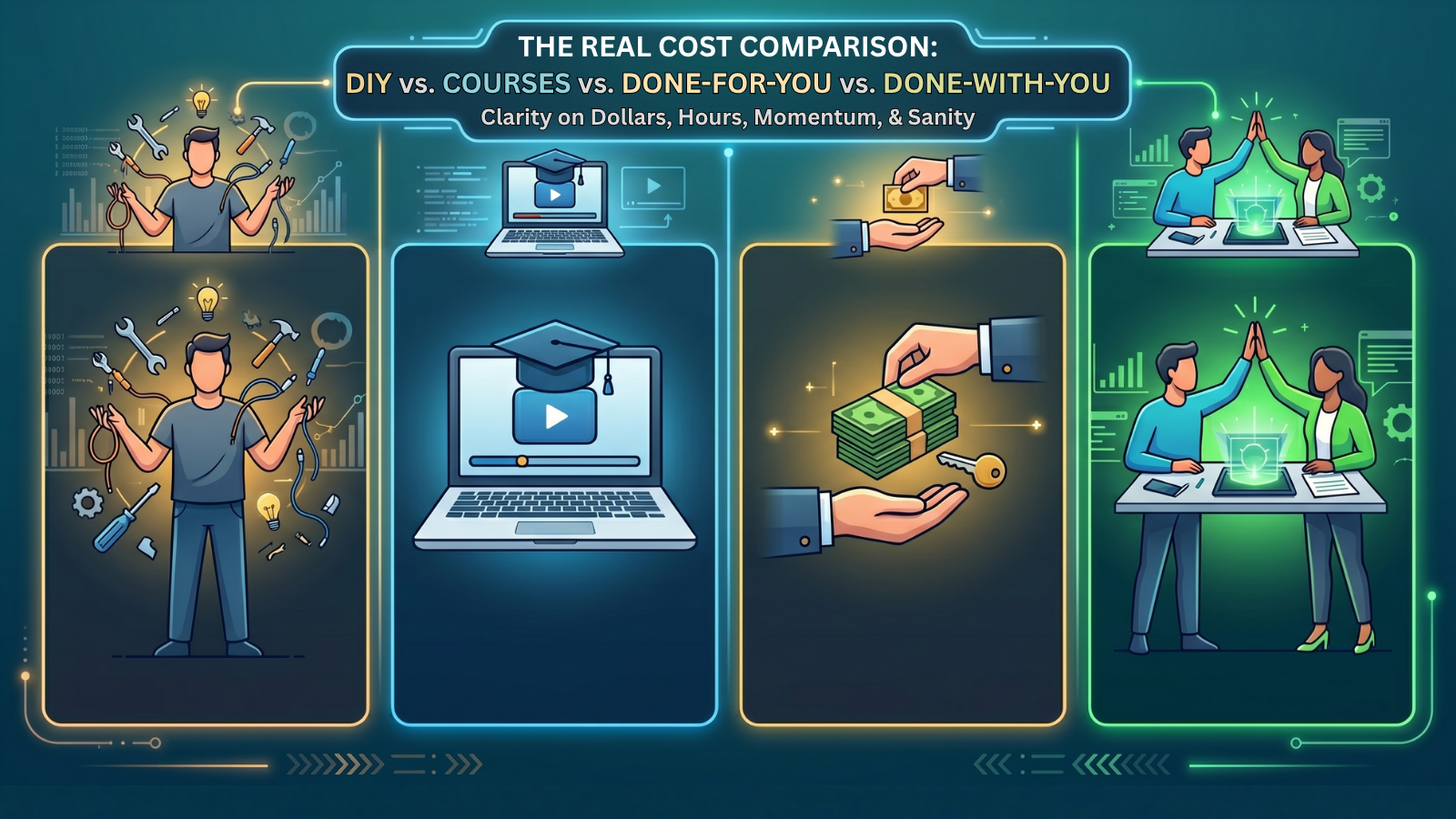
The Real Cost Comparison: DIY vs. Courses vs. Done-For-You vs. Done-With-You

What's the real cost of getting your systems right? We break down every option so you can choose wisely.
You've got 47 browser tabs open. Three half-built landing pages. An email list that isn't actually connected to anything. A course you bought six months ago sitting at 12% completion. And a growing suspicion that "I'll figure it out this weekend" has become the most expensive sentence in your business.
Here's the truth nobody talks about: the sticker price is never the real price.
When you're overwhelmed by tech, you don't need another tool. You need clarity on what each path actually costs—in dollars, in hours, in momentum, and in the silent tax on your sanity that I call TechXiety.
So let's cut through the noise. No corporate jargon. No hype. Just real numbers, real tradeoffs, and what actually happens when you choose each path.
The Four Paths at a Glance
| Path | Upfront Cost | Time to Working System | Hidden Costs | Ownership Level |
|---|---|---|---|---|
| DIY | $50–$500/month in tools | 40–120+ hours | Opportunity cost, tech debt, decision fatigue | High (but shaky) |
| Courses | $97–$2,000 | 10–40 hours of watching | Implementation gap, abandonment, confusion | Medium (theoretical) |
| Done-For-You | $1,500–$15,000+ | 2–8 weeks | Dependency, revision cycles, maintenance | Low (it's theirs, not yours) |
| Done-With-You | $197–$1,500 | 4–6 hours | None significant | High (you built it together) |
Path 1: DIY — The Most Expensive "Cheap" Option
The promise: "Just watch a few YouTube videos. How hard can it be?"
The reality: You're paying with the one resource you can't scale—your time, your focus, and your decision-making bandwidth.
The Sticker Price Looks Innocent
A Squarespace account is $16/month. ConvertKit starts at $9. Skool is $99. Notion is free. Individually, these feel like coffee money. But here's what the landing pages don't show you:
41% of small business owners report that their software costs increased in the past year, and nearly a quarter aren't even sure what they're spending. The subscription creep is real, and it's not just the money—it's the mental overhead of managing a dozen tools that were supposed to reduce your workload. Small Business Expo Research Desk, 2026
The Shadow Cost: Your Time
Research shows that entrepreneurs spend 36% of their workweek on administrative tasks—invoicing, data entry, scheduling, chasing payments, formatting documents. That's not revenue-generating work. That's not client delivery. That's maintenance on a machine you never finished building. Forbes / Time Etc Survey, 2023
Some studies put that number even higher—up to 40% of the workweek trapped in admin duties alone. Nearly half of entrepreneurs report feeling burnt out from these tasks. Adobe / IBIAB Systems Research, 2025
Let's do the math nobody wants to do:
If your time is worth $100/hour (conservative for a professional or creator), and you spend 60 hours over three weekends trying to connect your website to your email to your calendar to your community platform... that's $6,000 in opportunity cost. And that's assuming you succeed.
The Tech Debt Trap
DIY doesn't just cost time upfront. It creates tech debt—the accumulated cost of suboptimal choices made because you didn't know what you didn't know.
- The automation that breaks when you hit 100 subscribers because you built it on a free Zapier plan
- The website that loads in 4.8 seconds because you used 12 plugins to do what one proper setup could handle
- The email sequence that goes to spam because you never configured DNS records properly
These aren't character flaws. They're the predictable result of doing a job you were never supposed to be an expert in.
The Decision Fatigue Tax
Every tool comparison, every "which platform should I use?" Reddit thread, every abandoned setup attempt drains your cognitive capacity. 1 in 3 small businesses report feeling overwhelmed by the pace of technology change, with real estate and creative industries hit hardest. Even tech-savvy business owners feel the pressure. Small Business Expo, 2026
DIY Verdict: Cheap on paper. Expensive in reality. High risk of abandonment, tech debt, and burnout.
Path 2: Courses — The Knowledge Gap That Never Closes
The promise: "Learn at your own pace. Master the skills. Build it yourself with expert guidance."
The reality: Most people don't finish. And finishing doesn't mean implementing.
The Completion Crisis
Let's look at the data that should terrify every course buyer:
The median completion rate for online courses is 12.6%. That means 87–88 out of every 100 people who enroll never finish. For massive open online courses (MOOCs) on platforms like Coursera and edX, completion rates are even bleaker—MIT found just 3.13% of learners completed their courses between 2017–2018. International Review of Research in Open and Distributed Learning, 2026
Other research confirms the pattern: only 15% of online learners complete their courses, even though 60% intended to when they enrolled. Columbia University tracked this gap between intention and action. BloggingX / Columbia Research
52% of people who register for a course never even look at the courseware. They buy the promise, not the process. NARU / Medium Analysis, 2026
Why Courses Fail (It's Not the Content)
The content is usually fine. The problem is the implementation gap—the chasm between "I understand this concept" and "my website actually captures emails and sends the right sequence to the right people."
Courses work when:
- You have a simple, single-skill goal (learn Excel pivot tables)
- You already have a working system and need to optimize one piece
- You're in a cohort with accountability, peer pressure, and live support
Even then, the data shows self-paced courses average 10–20% completion, while scheduled cohort courses jump to 64.2%—but that's still only two-thirds of people. Community-driven courses with active discussion can reach 85–96% completion, but those are the exceptions, not the rule. Ruzuku Platform Data, 2026
The Hidden Curriculum
What courses don't teach you:
- How to debug why your form isn't submitting (because your hosting blocks the API)
- Which tool to choose when you have three overlapping needs and a $200/month budget
- What to do when the instructor's recommended plugin was acquired by a private equity firm and now costs 4x more
- How to recover when you break something at 11 PM and your launch is tomorrow
Courses Verdict: Low completion, high abandonment, massive implementation gap. You're paying for knowledge, not results.
Path 3: Done-For-You — Fast Results, Slow Dependency
The promise: "Hand it off to an expert. Focus on your zone of genius."
The reality: You get a working system you don't understand, can't maintain, and are afraid to touch.
The Sticker Price Range
For a professional small business website, you're looking at:
- Freelancers: $500–$5,000 Contra / The Web Factory, 2025
- Boutique agencies: $3,000–$15,000 The Web Factory, 2025
- Full-service agencies: $10,000–$50,000+
Add email setup, automation, community platform configuration, and AI integration, and you're easily in the $5,000–$20,000 range for a complete system.
The Dependency Problem
Done-for-you is seductive because it removes the immediate pain. But it creates a new one: you now have a business-critical system that you don't own intellectually.
What happens when:
- You need to change your offer next quarter?
- The automation breaks and the freelancer is booked for three weeks?
- You want to add a new lead magnet and have no idea where it fits in the existing flow?
- The agency used a custom-coded solution that requires their $200/hour retainer to maintain?
You're not independent. You're just outsourcing your confusion to someone else's calendar.
The Communication Tax
Done-for-you projects require extensive scoping, revision cycles, and back-and-forth. A project quoted at "2 weeks" often stretches to 6–8 weeks because:
- You didn't know what to ask for in the brief
- The deliverable doesn't match your mental model
- Scope creep happens on both sides
- You're waiting for feedback while they're waiting for assets
The Maintenance Trap
Websites and systems aren't "set and forget." Plugins update. APIs change. Platforms modify their terms. Without understanding your own setup, every maintenance need becomes another invoice.
Industry data suggests budgeting 10–20% of your development cost annually just for maintenance. The Web Factory, 2025
Done-For-You Verdict: Fast initial results. High ongoing dependency. Low ownership. Expensive over time.
Path 4: Done-With-You — The Middle Path That Actually Works
The promise: "Build it together. Learn while it happens. Leave with working systems you understand."
The reality: This is what most overwhelmed operators actually need, but almost nobody offers it cleanly.
What Done-With-You Actually Means
Done-with-you isn't "I'll watch you do it." It's not a group coaching call where everyone talks about their feelings and nobody touches code.
It's live, hands-on implementation where:
- You show up with your scattered system
- An expert guides the build in real-time
- You make decisions about your business (offers, messaging, flow)
- The expert handles the technical execution
- You see exactly how it's built
- You leave with working systems and the knowledge to maintain them
Why the Model Works
The data on implementation and learning is clear: when people learn while doing with expert support, outcomes dramatically improve.
Consider the contrast in course completion: self-paced courses sit at 10–20% completion, while cohort-based courses with active peer discussion reach 85–96% completion. The difference isn't the content. It's the live container, the accountability, and the ability to ask "what do I click right now?" Ruzuku / HBS Online Data, 2026
Done-with-you applies this same principle to implementation, not just learning. You're not watching a video about how to set up an email funnel. You're setting up the email funnel while someone who has done it 200 times guides your cursor.
The ROI of Proper Implementation
Business automation research shows that when systems are properly implemented (not just purchased), the returns are substantial:
- AI and automation can reduce 20–40% of time spent on repetitive tasks McKinsey / Cornell Design Group, 2023–2025
- Organizations often achieve ROI of around 200% within 12 months of automating core processes Everest Group / ThinkAutomation, 2026
- Expert delegators (people who know how to hand off and systematize) see 143% revenue growth compared to 80% for those who don't Forbes / Time Etc, 2023
The key phrase is properly implemented. A tool you bought but never configured has an ROI of negative whatever you paid for it. A system you built together with an expert, tailored to your actual workflow, starts generating returns immediately.
The Real Cost Breakdown
| Cost Category | DIY (3 weekends) | Course Bundle ($1,500) | DFY Agency ($8,000) | DWY Session ($297–$1,500) |
|---|---|---|---|---|
| Direct cost | $300/year tools | $1,500 | $8,000 | $297–$1,500 |
| Time invested | 60+ hours | 20+ hours | 5–10 hours (briefing/review) | 4–6 hours |
| Opportunity cost ($100/hr) | $6,000 | $2,000 | $500–$1,000 | $400–$600 |
| Implementation success rate | ~30% (abandoned projects) | ~15% (completed & applied) | ~85% (delivered) | ~95% (built live) |
| Knowledge retention | Low (forgotten between attempts) | Medium (theoretical) | None (they built it) | High (you did it together) |
| Time to working system | 3–8 weeks (if ever) | 4–12 weeks (if implemented) | 2–8 weeks | 4 hours |
| Total effective cost | $6,300+ | $3,500+ | $9,000+ | $700–$2,100 |
Note: Opportunity cost assumes your time has monetary value—which, if you're running a business or practice, it absolutely does.
What You Actually Leave With
In a done-with-you session (like the Tech Clarity Intensive), you don't leave with a to-do list. You leave with:
- A working website connected to your domain
- An email system that captures and nurtures leads
- Automated workflows that handle repetitive tasks
- A community or client portal configured for your actual offers
- Documentation of what was built and why
- The confidence to modify it yourself
No homework. No "watch these 47 modules." No waiting for a developer to respond to your Slack message.
Done-With-You Verdict: Highest implementation success rate. Lowest time-to-result. You own the system. You understand the system. No dependency, no abandonment, no TechXiety.
The Decision Framework: Which Path Is Right for You?
Choose DIY If:
- You genuinely enjoy tinkering with tech (not just saying that to avoid spending money)
- You have more time than money right now
- Your system needs are extremely simple (one landing page, one email form)
- You have a technical background or patient mentor available
Reality check: Most people who choose DIY underestimate the time cost by 3–5x and overestimate their follow-through by 10x.
Choose a Course If:
- You need to learn a specific, narrow skill (not build an entire system)
- You have strong self-discipline and a history of finishing online programs
- You already have a working foundation and need to optimize one piece
- You can join a cohort with live support (not self-paced)
Reality check: The completion data is brutal. If you wouldn't finish a 10-hour course on a Saturday, you won't finish a 40-hour business systems course in your "spare time."
Choose Done-For-You If:
- You have capital and zero time
- Your needs are complex and custom (enterprise-grade requirements)
- You genuinely don't want to understand the tech (you want a chauffeur, not a driver's license)
- You have budget for ongoing retainer support
Reality check: The dependency is real. Every change, every fix, every "how do I...?" becomes a billable event.
Choose Done-With-You If:
- You're overwhelmed by choices and need clarity fast
- You want working systems this week, not next quarter
- You need to understand what you built (for confidence and future modifications)
- You value your time but don't have agency-level budgets
- You learn by doing, not by watching
Reality check: This requires showing up and making decisions about your business for 4 hours. It's not passive. But it's the fastest path from scattered to setup.
The Hidden Cost Nobody Talks About: TechXiety
There's a cost that doesn't show up in spreadsheets: the psychological weight of unfinished systems.
Every half-built website, every disconnected automation, every "I'll get back to this" project sits in your mental RAM. It drains your capacity for creative work, client delivery, and strategic thinking.
When your tech is scattered, your mind is scattered. When your systems are working, your mind is free.
That clarity has a value. Probably the highest value of all.
Final Numbers: The Honest Comparison
| Metric | DIY | Courses | Done-For-You | Done-With-You |
|---|---|---|---|---|
| Upfront cash | Low | Medium | High | Medium |
| Time to result | 3–8 weeks | 4–12 weeks | 2–8 weeks | 4 hours |
| Total effective cost | $6,000+ | $3,500+ | $9,000+ | $700–$2,100 |
| Ownership level | Shaky | Theoretical | None | High |
| Implementation rate | ~30% | ~15% | ~85% | ~95% |
| Ongoing dependency | None (but tech debt) | None | High | None |
| Anxiety level | High | Medium | Low (initially) | Low |

The Bottom Line
You don't need perfect. You need working.
You don't need to become a developer. You need systems that serve your business while you sleep.
You don't need another course to bookmark. You need someone to sit with you, build it live, and hand you the keys.
The real cost of getting your systems right isn't the invoice. It's the weeks of delay, the abandoned projects, the decision fatigue, and the opportunity you miss while you're still "figuring it out."
Done-with-you isn't the cheapest option on paper. It's the cheapest option in reality—because it works the first time, you own the result, and you can move on to actually running your business.
Your shit, working. That's the promise. And that's the real cost comparison.
Ready to stop comparing options and start building? Reserve your spot in the next Build With You session — 4 hours from scattered to setup, live and together.
Sources & References
- Small Business Expo Research Desk — Software Costs Rising for 41% of SMBs (2026)
- Small Business Expo — 1 in 3 SMBs Struggle With Technology Change (2026)
- Forbes / Time Etc — Entrepreneurs Spend 36% of Time on Admin Tasks (2023)
- Adobe / IBIAB Systems — Work-Life Balance & Admin Burnout Trends (2025)
- International Review of Research in Open and Distributed Learning — MOOC Completion Rates Revisited (2026)
- Ruzuku — 71 Online Course Statistics: Completion Rates (2026)
- BloggingX / Columbia University — Online Course Completion Rate Statistics
- NARU / Medium — Why 95% of Online Courses Fail (2026)
- The Web Factory — How Much Does a Website Cost in 2025?
- Contra — Freelance Web Developer Cost Guide (2025)
- Cornell Design Group — AI Automation ROI for Small Businesses (2025)
- ThinkAutomation — Business Automation ROI Statistics (2026)
- U.S. Chamber of Commerce — Impact of Technology on Small Business Report (2024)
Frequently asked questions
- Is done-with-you really cheaper than DIY?
- On paper DIY looks cheapest, but when you factor in 60+ hours and opportunity cost at $100/hour, DIY often totals $6,000+ with a ~30% chance of a working system. Done-with-you typically lands at $700–$2,100 with ~95% implementation success in one session.
- Why do most online courses fail to deliver results?
- The median completion rate is about 12.6%, and finishing still doesn't guarantee implementation. Courses teach concepts; they rarely walk you through connecting your actual website, email, and workflows live.
- When does done-for-you make sense?
- When you have significant budget, complex custom requirements, and ongoing retainer support—and you're comfortable not owning or understanding the system yourself.
- What's the fastest path to working systems?
- A done-with-you build session: 4 hours live with an expert, your stack configured for your business, and you leave understanding what was built. See Build With You on our offer page.
Want personalized help?
Get the free Tech Clarity Decision Framework or book a clarity session — no pitch.
Get the free guide