AI Isn't Magic: Why Your Integration Needs a Real Plan (And How to Do It Right)

AI can help your business—but only if you know where it fits. Here's how to integrate without the hype.
You've heard the pitch a thousand times by now.
"AI will 10x your productivity."
"Automate everything."
"Just plug it in and watch the magic happen."
Here's what nobody's saying out loud: most AI projects fail. Not kinda fail. Not "we learned something" fail. Full-on, money-gone, system-abandoned, back-to-spreadsheets fail.
And if you're a small business owner or solo operator already drowning in tech choices, the last thing you need is another shiny tool that becomes another half-built project sitting in your mental RAM.
So let's talk about what AI actually is, where it actually fits, and how to integrate it into your business without becoming a statistic.
The Hype vs. The Hard Numbers
Let's start with the reality check that should be on every AI sales page but isn't.
According to RAND Corporation research, more than 80% of AI projects fail to deliver their intended business value—roughly double the failure rate of traditional IT projects. That breaks down to: 34% abandoned before production, 28% completed but delivering no value, and 18% delivering some value but unable to justify the cost. Only about 20% achieve what they set out to do. RAND Corporation / Pertama Partners, 2026
For generative AI specifically—the ChatGPTs, Claudes, and Copilots everyone's buzzing about—MIT Sloan's 2025 research found that 95% of GenAI pilots fail to scale to production deployment. Infrastructure limitations account for 64% of these scaling failures, and cost overruns average 380% at production scale versus pilot projections. MIT Sloan / SRA Analytics, 2025
S&P Global's 2025 survey put it in even starker terms: 42% of companies scrapped most of their AI initiatives in 2025, up sharply from just 17% the year before. The average organization abandoned 46% of AI proof-of-concepts before they ever reached production. S&P Global / Beam AI, 2025
This is not a technology problem. The models work. The tools function. The failure is in the integration—the gap between "we bought AI" and "AI is actually making our business run better."
What Small Businesses Are Actually Doing With AI
Now, here's the twist: small businesses are adopting AI. Fast.
BizBuySell's 2026 Insight Report found that nearly 2 in 3 small businesses are now using AI, and 83% of those report measurable performance gains. Adoption spiked in early 2025—a 127% increase from 2023. BizBuySell, 2026
The U.S. Chamber of Commerce reports that 58% of small businesses currently use generative AI, up from 40% in 2024. A stunning 96% plan to adopt emerging technologies including AI. U.S. Chamber of Commerce, 2025
But here's the critical distinction: most small businesses are using AI for peripheral tasks, not core transformation.
The OECD's 2025 research found that among SMEs using generative AI, only 29% report using it in their core business activities. The rest? Marketing content, social posts, email drafting, research—useful, but not transformative. OECD, 2025
77% of small business owners use AI for marketing. 56% use it for analytics. 42% for research. These are valuable use cases, but they're additive—they make existing tasks faster, they don't redesign how your business actually operates. BizBuySell, 2026
The gap between "using AI for content" and "using AI to automate your client onboarding, qualify leads while you sleep, and route inquiries without touching them" is massive. Most small businesses haven't crossed it. Not because they can't, but because nobody gave them a plan for integration.
Why AI Integration Fails (The Real Reasons)
If the technology works and adoption is high, why do so many projects crater? The research points to the same culprits again and again—and almost none of them are about the AI model itself.
1. You Started With the Tool, Not the Workflow
RAND Corporation identified the #1 cause of AI failure: misunderstood problem definition. Stakeholders miscommunicate what problem AI needs to solve. The model gets built for the wrong job. RAND Corporation / Talyx AI, 2024
This is the "technology-first mentality" trap. You see a demo of an AI tool that looks incredible. You buy it. Then you realize you have no idea where it fits in your actual day-to-day operations.
The fix: Define the workflow first, then select the tool. Not the reverse.
2. Your Data Is a Mess (And You Know It)
EY Research found that 83% of senior leaders cite poor data infrastructure as a major AI adoption bottleneck. McKinsey's 2024 survey found that 70% of generative AI high performers had experienced data-related difficulties. EY / Alation, 2026
For small businesses, this doesn't mean you need a data warehouse. It means your client info lives in three places, your email list hasn't been cleaned since 2022, and your "automation" is actually you copy-pasting between tabs.
AI can't fix fragmentation. It amplifies it. Feed a messy system into an AI tool and you get faster mess.
3. No One Defined Success Before the Build Started
73% of failed AI projects lack clear executive alignment on success metrics. 61% treat AI as an IT project rather than a business transformation. RAND Corporation / Pertama Partners, 2026
Translated for small business: you bought the tool because it felt like progress, not because you knew exactly what "better" looks like in 30 days.
"Save time" is not a metric. "Reduce client onboarding from 45 minutes to 5 minutes" is.
4. The Integration Layer Doesn't Exist
This is where most small businesses get stuck. The AI tool works fine in isolation. But your business doesn't run in isolation.
Your website needs to talk to your email platform. Your email platform needs to trigger your scheduling tool. Your scheduling tool needs to update your CRM. Your CRM needs to notify your community platform. And somewhere in that chain, a human (you) needs to know what's happening without checking six dashboards.
The real challenge is rarely the model. It's workflow integration and software integration. Evinent, 2026
Without that connective tissue, AI is just another tab in your already overcrowded browser.
5. No One Owns It After Launch
AI isn't a microwave. You don't press a button and walk away. Models degrade. Data shifts. APIs change. Workflows evolve.
Organizations that skip continuous evaluation aren't deploying AI. They're deploying a degrading snapshot of what their data meant at a particular moment in the past. Alation, 2026
For a small business, "ownership" means you understand what was built, why it was built that way, and how to adjust it when your business changes. Not your developer. Not your VA. You.
The Real Plan: How to Integrate AI Without the Carnage
You don't need an enterprise data team. You don't need a six-figure budget. You don't need to become an AI engineer.
You need a plan that respects the reality of your business: limited time, limited budget, and a desperate need for things to actually work.
Phase 1: Audit Before You Automate (Week 1)
Before you buy a single AI tool, map what you actually do.
Questions to answer:
- What tasks eat my time every week? (Be specific: "email" is not a task. "Answering the same 5 client questions via email" is.)
- Where does data enter my business? (Contact forms, DMs, referrals, events?)
- Where does data get stuck? (The spreadsheet you never update? The CRM you stopped using? The automation that broke?)
- What would "working" look like in 30 days?
Research shows that organizations reporting significant financial returns from AI are twice as likely to have redesigned end-to-end data workflows before selecting modeling techniques. McKinsey / QuickLaunch Analytics, 2025
For a small business, this means: clean your foundation before you add intelligence.
Phase 2: Pick One High-Value Workflow (Week 2)
There is a temptation to spread AI across your whole business at once. It feels ambitious. It also creates chaos fast.
A better approach: Start with one workflow that is important enough to matter and structured enough to improve.
Good candidates for small businesses:
- Lead response: AI qualifies inquiries and routes them based on intent
- Client onboarding: Automated sequence that delivers resources, schedules calls, and sets expectations
- Content repurposing: One piece of long-form content becomes a week of social posts
- Meeting prep: AI summarizes client history and drafts agenda before every call
- FAQ handling: AI drafts responses to common questions; you review and send
Bad candidates (for now):
- Replacing your entire customer service with a chatbot
- Building a custom AI model for your business
- Automating a process you haven't manually mastered yet
OpenAI's enterprise materials make a useful point here: AI tends to create the most value when it is connected to core business functions, not when it sits in experimental isolation. Evinent, 2026
Phase 3: Build the Integration Layer (Week 3)
This is the step most people skip—and it's why their AI stays in "experiment" mode forever.
For your chosen workflow, map the data flow:
- Input: Where does the trigger come from? (Form submission, email, calendar event, purchase)
- Processing: What does the AI actually do? (Classify, draft, summarize, route)
- Output: Where does the result go? (Email sent, CRM updated, Slack notified, task created)
- Human checkpoint: Where do you review, approve, or intervene?
- Fallback: What happens when it breaks or gets confused?
You don't need custom code for most of this. Tools like Zapier, Make, or native integrations handle 80% of small business workflows. But you do need to design the flow before you connect the tools.
Poor data quality, fragmented ownership, and weak interoperability are still among the biggest reasons AI programs fail to scale. McKinsey / SmartDev, 2024
Phase 4: Measure, Refine, Own (Ongoing)
Set one operational KPI for your AI workflow before you turn it on:
- Response time reduced from X to Y
- Hours saved per week on Z task
- Client satisfaction score for automated touchpoints
- Lead qualification accuracy (how often did the AI route correctly?)
If you're not measuring what changed, you're guessing. Evinent, 2026
And critically: document what you built. Not for a boardroom. For you. So when something breaks at 9 PM before a launch, you know which tool does what, which integration connects where, and how to fix it without starting over.
What "Done Right" Looks Like for a Small Business
Let's ground this in reality. Here's what proper AI integration looks like for a typical overwhelmed operator—a coach, consultant, creator, or service provider:
Before:
- Lead fills out website form
- You get an email notification
- You copy their info into a spreadsheet
- You manually send a welcome email 2–3 days later (if you remember)
- You DM them to schedule a call
- They don't respond
- You follow up again
- They book, but you have to manually send prep materials
- You spend 20 minutes before every call reviewing notes scattered across three apps
After (integrated AI workflow):
- Lead fills out website form
- AI classifies their intent (inquiry vs. ready-to-buy vs. just browsing)
- High-intent leads get an immediate personalized email with your scheduler
- Medium-intent leads enter a 3-email nurture sequence you pre-wrote
- Low-intent leads get a resource and a gentle follow-up in 7 days
- When they book, AI preps your meeting brief: their form answers, your last interaction, suggested talking points
- You show up informed and ready
The AI didn't replace you. It removed the 45 minutes of admin between "they're interested" and "you're talking."
That's the difference between using AI for content (helpful, peripheral) and using AI for operations (transformative, core).
The Skills Gap Is Real—But It's Not What You Think
McKinsey research shows that skills and training gaps are the #1 barrier to AI adoption, affecting 46% of business leaders. McKinsey / USM Systems, 2025
But the gap isn't "learn to code." The gap is learn to think in systems.
You don't need to understand transformer architecture. You need to understand:
- What triggers an automation
- How data flows between tools
- Where human judgment is required
- How to measure whether it's working
These are business skills, not technical skills. And they're learnable in hours, not months—if someone shows you while building it with you.
The Bottom Line: AI Is a Wrench, Not a Wizard
AI is not magic. It's a very powerful wrench. And like any wrench, it's useless if you don't know which bolt you're trying to turn.
The businesses winning with AI in 2025 aren't the ones with the most tools. They're the ones with the clearest workflows, the cleanest integrations, and the discipline to measure what actually changed.
67% of AI-adopting SMBs saw 20%+ revenue growth—but that's the 67% who implemented strategically, not the ones who bought ChatGPT Pro and hoped for the best. McKinsey / Crescent AI, 2025
The 80–95% failure rate isn't a reason to avoid AI. It's a reason to avoid bad AI integration.
Your 4-Hour Integration Reality Check
If you're reading this thinking, "I know I need AI, but I don't know where to start," you're not behind. You're just honest.
Most small business owners are in the same place: 89% are using AI in some form, but only 30% feel ready to scale it. AI Software Systems, 2025
The gap between "using AI" and "AI running your business" is exactly what a proper integration plan closes.
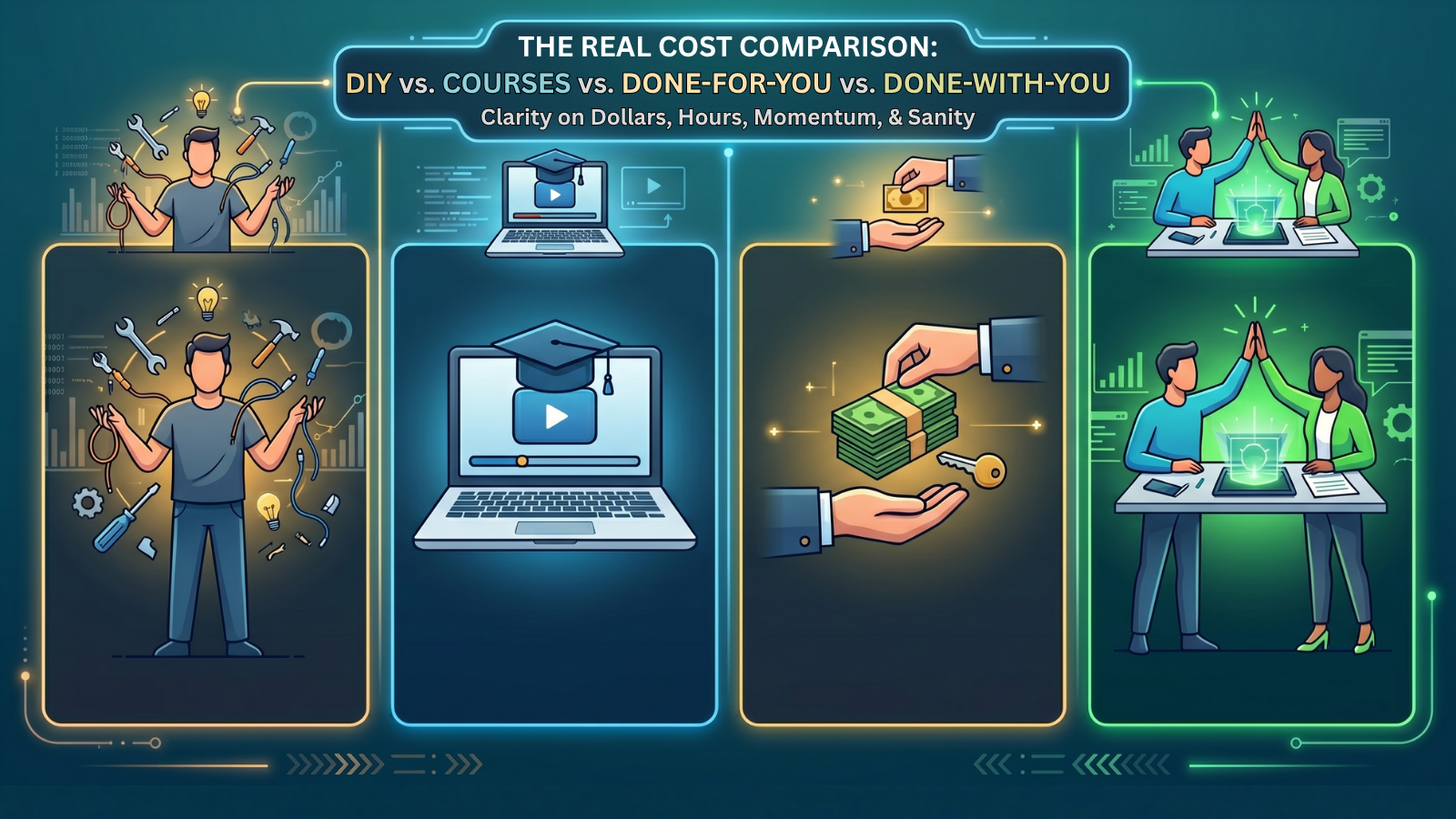
You don't need 40 hours of courses. You don't need a $10,000 agency build. You need 4 hours with someone who understands both your business and the tech—mapping your workflow, connecting your tools, and handing you a system you actually own.
Because AI isn't magic. But a working system? That kind of feels like it.
Stop experimenting. Start integrating. Book your Tech Clarity Intensive — 4 hours to map, build, and activate your AI workflow, live and together.
Sources & References
- RAND Corporation / Pertama Partners — AI Project Failure Rate 2026: 80% Fail
- MIT Sloan / SRA Analytics — Why 95% of AI Projects Fail and How Data Fixes It
- S&P Global / Beam AI — Why 42% of AI Projects Show 0 ROI
- RAND Corporation / Talyx AI — Why 90% of Enterprise AI Implementations Fail
- BizBuySell — Small Business AI Adoption Hits 63%: 83% See Results (2026)
- U.S. Chamber of Commerce — Empowering Small Business Report (2025)
- OECD — AI Adoption by Small and Medium-Sized Enterprises (2025)
- Evinent — AI Business Integration: Driving Efficiency and Strategic Growth (2026)
- Alation — Why Enterprise AI Projects Fail: 6 Root Causes and Fixes (2026)
- McKinsey / QuickLaunch Analytics — Why 80% of AI Projects Fail Before They Start (2026)
- SmartDev — Workflow Automation: Key Reasons for Enterprise AI Project Failure (2026)
- McKinsey / USM Systems — Small Business AI Adoption Statistics 2025
- AI Software Systems — AI Adoption in Small Businesses: 2025 Trends & Strategies
- McKinsey / Crescent AI — AI Automation for Small Business: Complete 2026 Guide
- Shawna Suckow — 5 AI Tools Every Small Business Owner Actually Needs (2026)
Frequently asked questions
- Why do most AI projects fail for small businesses?
- Usually not because the model is bad—because integration is missing. Tools sit in isolation, data is fragmented, success was never defined, and no one owns the workflow after launch.
- What's the first step before buying AI tools?
- Audit your workflows: what eats your time, where data enters and gets stuck, and what 'working' looks like in 30 days. Clean the foundation before you add intelligence.
- Should I use AI for marketing or operations first?
- Marketing AI is useful but peripheral. The biggest wins come from one core operational workflow—lead response, onboarding, or meeting prep—connected across your existing tools.
- How long does proper AI integration take?
- You can map, build, and activate one high-value workflow in about 4 hours with done-with-you support—versus months of DIY experimentation or abandoned pilots.
Want personalized help?
Get the free Tech Clarity Decision Framework or book a clarity session — no pitch.
Get the free guide